Mexican Spitfire

Thursday, July 24th, 2008 11:34 MDT

 The first time you buy a house you think how pretty it is and sign the check. The second time you look to see if the basement has termites. It’s the same with men.”

- Lupe Vélez, actress

Buenos Aires - I like celebrating people’s 100th birthdays or similar events for Casa SaltShaker dinners. They basically give me free rein to do a lot more interesting dishes, you know? Now, we’ve hosted some fairly famous centenaries here over the last many months, and I thought it would be fun to stretch the envelope a bit and celebrate a life that was over far too early. María Guadalupe Vélez de Villalobos was born in 1908 in San Luis Potosi, Mexico, to a colonel in the Mexican army and an opera singer. When old enough for school she was sent to San Antonio, Texas, to be educated in a convent, but she ran away to Mexico City to learn to dance when she was 13. Despite being hauled back to the convent, she continued her “tempestuous ways”, and eventually found her way to Hollywood in 1926, where, over the next 18 years she appeared in nearly four dozen films (save a brief interlude in a Cole Porter musical on Broadway), generally playing the beautiful, volatile girl opposite such comic stars as Jimmy Durante and Leon Errol. Though she never really rose above the “b-movie” level, she was well known for her very public private life as a party girl, and had tabloid covered affairs with a number of actors, including Gary Cooper, eventually married Johnny Weismuller (Tarzan), divorced, and an affair with a young actor named Harald Maresch. She got pregnant during this affair, and rather than have an abortion or bring an out of wedlock child into the world both of which she felt were the ultimate sins against the catholic church, she committed suicide by taking an overdose of sleeping pills at age 36. Adultery, sex outside of marriage, divorce, suicide… aren’t those against the rules too? Methinks there was more to it…

So there I was, with Lupe Vélez’ ghost hovering about and wondering if I was going to do something cool for her birthday or not. I have to admit, San Luis Potosi is not the first region of Mexico I tend to delve into when I cook Mexican food, so this gave me all the excuse I needed to do so. Turns out there are some pretty interesting dishes….

Cecina de res

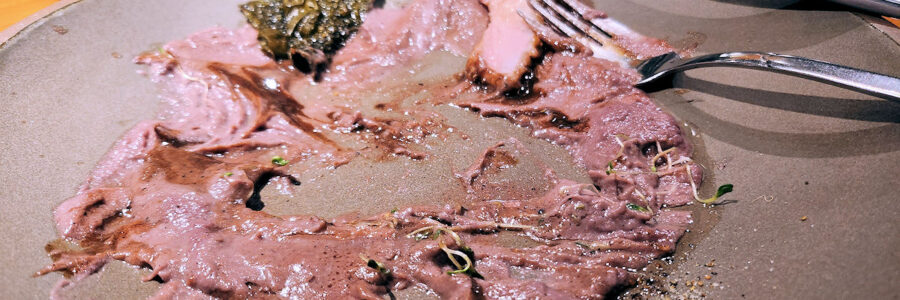
Initially I was thinking about the local dish cecina de res for a main course, but it’s basically salt beef, nearly beef jerky (Henry exclaimed “charqui!” which is the quechua term for it, as he was digging into a slice or two), that’s been only slightly reconstituted. Sometimes it’s even just served more or less as is. I just figured the saltiness would be too intense as a main course portion, and decided instead to offer it up as a first plate. The traditional method of making it with long air-dried and salted strips was a bit more than I have the setup to start doing, so I started the beef off with a “buried in salt” sort of cure, more or less the same as I do when I want to make gravlax. I thinly sliced peceto, or top round, coated both sides in a mix of orange and lime peel and juice, and dried oregano, all buried in a mix of salt and sugar. I left it in that for about 30 hours - 24 would have probably been enough. Then I scraped the mixture off, and laid the pieces out on racks set over drip pans, and brushed them with a mix of orange and lime juice, turning them after about 12 hours and doing the same thing again. I left them to air dry for another 24 hours, which ended up the perfect consistency. To serve, I sauteed the slices in a good amount of oil with garlic and onions, and served them with a fresh guacamole and a hot sauce made from vinegar preserved jalapeños. It was a little saltier than I’d have liked - a shorter cure if I do it again, or maybe even soaking the slices in the orange/lime mixture for a little while to draw out the salt before air drying. However, with the foil of the guacamole and hot sauce it worked really well.

Next up a sopa verde de elote, or green corn soup. The corn isn’t green, it’s simply a pureed soup of corn, peas, fire-roasted poblano peppers, onion, cilantro, a good amount of pre-cooked tomatillos (I finally found a source for fresh tomatillos, yay!), lettuce, and chicken stock, all then cooked together for just a short time - 15-20 minutes or so on simmer - seasoned to taste and served with some freshly chopped cilantro.

Huevos en Rabo de Mestiza

While the name of this dish, huevos en rabo de mestiza may have given “my boys” a giggly fit, the dish was my favorite of the evenings and that of several of the guests. (Since I know someone will ask rather than looking it up for themselves, let me just give you the translation - “eggs in a half-breed girl’s ass” - don’t ask me, I haven’t come up with anything.) It was also the most fun dish to make. I fire-roasted some jalapeño chilies, then sauteed them with thinly sliced white onion. I threw a bunch of plum tomatoes under the broiler until they were lightly browned, pureed them, mixed them with the chlies and onions and a little salt to taste, ladled the mixture into little cazuela dishes, and added a splash of water just to thin the sauce out. For serving, I heated the dishes with the sauce in the oven, then slipped an egg into the center of each and draped a slice of cheese over the top. Back into the oven for just long enough to set the whites and leave the yolks soft, out of the oven, sprinkled with chives, and served. This is generally considered more of a brunch type dish, but it sounded so good, and it’s not unheard of to serve it at dinner, and so I did.

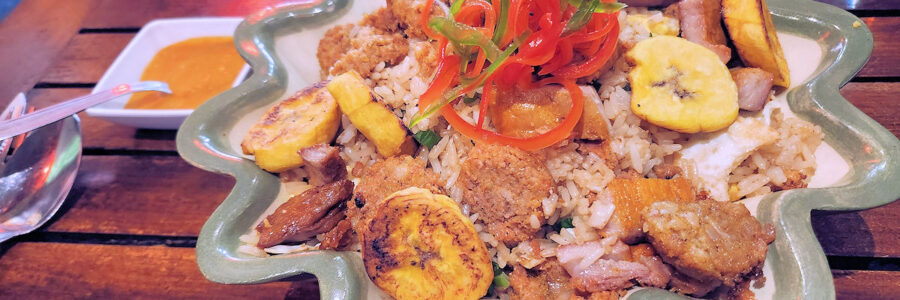
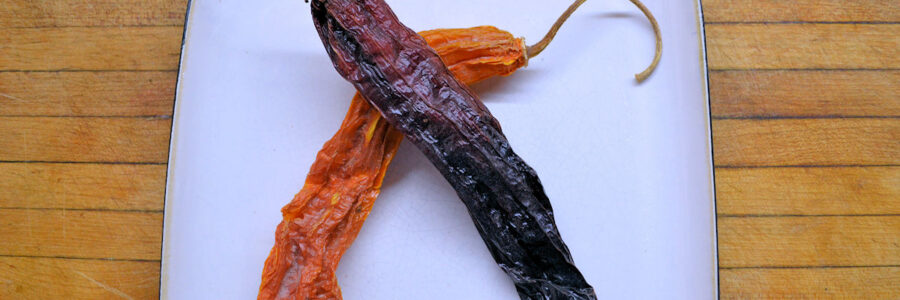
The main course was pollo en ajo-comino, or chicken in garlic and cumin. In a big saute pan I sauteed a mixture of cumin, garlic, ancho chili powder, and salt until it was nice and aromatic. Then I added chicken breasts to the mixture and cooked them until lightly browned. Earlier, I’d reconstituted some dried ají panca, the red sort, as dried Mexican peppers aren’t available here (anchos would have been the way to do it right), peeled and seeded them, and then pureed them with their cooking liquid. Once the chicken was browned, I added this puree to the pan (if there’s not enough liquid to cover the chicken, add a little water), covered it and simmered them until cooked through, about 20 minutes. Sliced and served atop freshly made wheat tortillas. Simple, but quite good.

Tarta de frutas con cajeta

Cajeta is the Mexican name for what here is called dulce de leche, or milk caramel. I made a batch. Then I cut up some fresh pineapple, papaya, and kiwi and simmered them in a little sugar syrup until soft. I made some tart shells out of overlapping squares of phyllo dough brushed with butter and then browned in the oven. To serve, I warmed the cajeta and the fruit, filled the tart with the former and topped with the latter, and served. Once again simple, but really good - and although the tart idea isn’t traditional, the fruit and cajeta mixture is a classic way to end a San Luis Potosi meal.

I wonder if I can find any copies of the old Mexican Spitfire films around…

The End

The Supremes - Take 1

Tuesday, July 22nd, 2008 11:14 MDT

 Although the Assembly of 1813, as a representative body, did not comply with its fundamental objective of sanctioning a constitution, it developed a vast legislative activity pro individual freedom and constituted the opening into new institutional modes. From the point of view of the political organization, it established a Unipersonal Executive Power, creating the position of Supreme Director of the United Provinces of the Río de la Plata. It instituted May 25 as a patriotic date, established the Coat of Arms and the Anthem and ordered to mint an own coin, actions through which it demonstrated its will to create a sovereign state.”

- Official website of Argentina

La Vida de Gervasio Antonio de PosadasBuenos Aires - I started off a week or so ago with a cursory look at the history of the leadership of Argentina. To continue… if I were to want to write about one of the past leaders of the United States, or, for that matter, most countries, and I could read the language, I could probably walk into any good bookstore or library and find a biography, autobiography, memoir, or historical tome that covered their life. You could probably find the same for many other historical persons - revolutionaries, statesmen, even the occasional vice-president. Not so much here in Argentina. Oh, the major figures of history have their volumes - often multiple shelves worth of books. But the lesser known figures stay that way. Out of the seven different people who served as Supreme Director during the early years of Argentina’s post-colonial period, I’ve been able to find works about five of them - and that took visiting several dozen bookshops and libraries, delving into government archives, and online searches. The best guess on the part of various folk I talked to is that one of the remaining probably never had anything published about him, and the other, they’re quite sure must exist, but there seem to be no records of such a book. I decided against purchasing a copy of Gervasio Antonio de Posadas’ memoirs - the $700 and on up price tag was just a bit more than I was up for. I finally found a copy of his biography in the corner of a dusty old bookstore, where I picked it up at significantly less than the $55-100 prices that I found in the few other stores, all online, that had copies on offer. It’s been a fascinating read and look at the man who was the first official leader of this nation.

Now, how does one sum up someone like this in a paragraph or two? He was born June 19, 1757, his father and both his grandfathers being military officers serving under the Spanish Viceroy. At an early age he was educated by the Jesuits, until the time when the Jesuits were expelled from the country, after which he was moved to a Franciscan school. He excelled in Latin, Philosophy, and Theology, and continued on to study law under a series of increasingly powerful members of the Viceroyalty. He was well respected, accomplished, and had quietly gathered a fair amount of wealth for himself. At age 32 he married the daughter of one of the most respectable families in the region which gained him entry into the top social circles as well. They had five children - a boy and four girls.

In the early 1800s, as unrest began to grow in the area, he found himself in a state of limbo of sorts, as various factions began to appear, the viceroyalty collapsed due to the overthrow of the Spanish monarchy, the English invaded in 1806-7 - and one of the commanders took over Posadas’ home and grounds as his personal command center, turning he and his family out into the street. They took refuge in a local convent, where his wife died, and he threw himself into the cause of the colonial rebels - or at least one faction. And this gets back to my previous post about the constant internal change within Argentine. In the course of a few years, he found himself at various times allied with those in power or those out of - but none of them working together - at one point he was exiled from the country, only to be recalled a few weeks later when someone else was in charge of the governing committee. Eventually, he found himself drafted to replace one of the original members of the “Second Triumvirate”, charged with drafting a constitution for the new republic, and being selected as the most stable of its members to govern as the country’s first Supreme Director, a position in which he served for almost a year, primarily focused on issues related to unifying the new republic and completing the work on the constitution, until being replaced by his cousin (not his nephew as many sources have cited, historical research shows they were related through Posadas’ mother’s family), General Carlos María de Alvear, who wanted to see the English monarchy replace the new rule by former colonists. After the Alvear faction fell (we’ll get to that in a future post), he was jailed as a collaborator simply for his familial relationship, and spent six years incarcerated in, at various moments, 22 different prisons. In 1829 he began writing his memoirs, and completed them shortly before he died, July 2, 1833; though they were not published until 1914.

And that, leads us to the modern day, and our little walking tour in Recoleta. Really, it does, because behind all those delving into early historical lives was simply a reason to go out and wander. To the best I’ve been able to determine, there is no monument to Posadas here in the city (there is a city named Posadas up in the north, the capital of Misiones province), and, as well, there does not appear to be either a Posadas or Davíla (his mother’s side) family mausoleum in the Recoleta cemetery - though, many historic figures were buried either in Chacarita or elsewhere, so that isn’t particularly telling. There is, however, an eight-block stretch of street in Recoleta named after him (I’m fairly certain it isn’t named after Juan Posadas, the pseudonym of a somewhat wacko early 20th century Trotskyite leader), and we’re going to walk it…

The Recova

Posadas begins at #1000, off the lower end of Av. 9 de Julio, or at least its service road, Carlos Pellegrini. Given my/our food focus, it should be noted that the endpoint is the well-known restaurant (which I have yet to visit) Juana M. In fact, the whole of the street starts in the midst of food, with the famed Recova, or “under cover” commercial center, taking up both sides of the street and stretching under the 18 lanes of the avenue, and filled with a combination of nearly a dozen very expensive restaurants - mostly steakhouses and Italian food - and an outdoor art gallery, with a constantly changing exhibit of local artists’ work. I have to admit to having avoided dining at any place within the Recova - not because there aren’t probably some very good restaurants, but they’re just so expensive it isn’t worth it for me (the main branch of Piegari, asserted by some to be the best Italian food in the city, is here, but with prices like 60-70 pesos for a bowl of pasta… you know?).

The Four Seasons

But luxury is what this end of Posadas, well, most of this area of Recoleta is about, and immediately on emerging from underneath the overpass, we find ourselves confronted by the impressive bulk of The Four Seasons hotel, one of the most expensive in the city (likewise its high end restaurant, La Mistral). This is a place where I regularly hear from visitors that they’ve booked, and don’t understand why people say Buenos Aires is so inexpensive in comparison to other world capitals. Of course, they’re probably eating in the Recova and dining at Casa SaltShaker as well, so there you have it. The next block or so include a series of large, but not particularly interesting apartment and professional office buildings, until we arrive into the 1200 block, with the towering Caesar Park hotel on the left at 1232 (with an excellent cocktail bar, and what I hear are two quite good, if expensive, restaurants, Agráz, and the new Japanese themed Midori).

Patio Bullrich

Of more interest, across the street is the Patio Bullrich shopping mall, an imposing building originally designed as the city center’s cattle auction hall in 1921, and refurbished as a shopping center in 1988 after a period of disuse. “The Patio” as locals call it, is designed around international luxury brands - mostly clothing. There’s also a small food court, with nothing of great note, though the upper floor of the center is home to the Recoleta branch of Valenti, a gourmet provider of cheeses, cured meats, and similar sorts of things. There’s also a cinema inside, with a half dozen small rooms, on different levels of the mall, showing everything from popular to “art” films, and is often the site for touring film festival showings.

El Sanjuanino and Fervor

On the next block is, for me, the most important food stop of this short trek - El Sanjuanino, which over the last couple of years has become my favorite spot to take visitors for good “regional” cuisine. Next door is the newly opened Fervor, a seafood restaurant I have yet to try, but which stands out for their unique, bizarre, and utterly useless attempt to accommodate the vast number of international visitors to the city - instead of translating the local fish names on the menu into one or another foreign language, they’ve listed the fish by their Latin genus and species, as if that will somehow clue the average person in to what they are ordering. I’m not even sure I can give them points for trying; still, it’s a pretty room, and for the ‘hood, their prices aren’t bad, so one of these days. Next door, the Melia Recoleta Plaza hotel, with its mediocre restaurant and attached jazz club. This block, by the way, is, while not famed for it, the original home (#1547) of the young radio actress, Eva Duarte, who lived on the fourth floor, and met her husband to be, Colonel Juan Perón, when he moved into the apartment next door (not at some party as the movies love to depict). In fact, they lived for their first year together on this street, and Evita gave her propaganda speeches from the then state radio station housed in the building where we will end this tour, the Palais de Glace.

Rear entrance of the Palacio Duhau

The following block stands out, in slightly bizarre fashion, for the rear entrances of the three buildings that take up most of the entire lefthand side - the Vatican embassy, the Palacio Duhau Park Hyatt, and the other half of the original Duhau estate, now a private home. The 1600 “block” splits in two on the left, with a small side street separating that side in two. Continuing past this…

Russian Embassy

On the right, at 1641 are the offices of the Treasury Proxy (don’t ask, I don’t know), at 1659 the Argentine Electrotechnical Association, and, at 1663, the Russian embassy (picture above); on the left at the end of the block, an apartment building at 1648 where Adolfo Bioy Casares and Silvina Ocampo, two of Argentina’s most famous 20th century writers, lived - originally lovers and later married. The former is most famous for his fantasy book La invención de Morel, the English translation of which has been asserted to be the inspiration behind the hit television show Lost; the latter well-known for her poetry and children’s stories.

1700 block of Posadas

Palais de Glace

And finally, the 1700 block, with a small park that is filled with massive rubber trees (more about which on the next neighborhood walk) on the left, and on the right mostly nondescript residential buildings, and finally at 1725, the Palais de Glace, built in 1880, and at various times home to an ice skating rink, the Belgrano radio station where Evita used to give speeches glamorizing the Perón policies, television channel 7, and now the slightly rundown National Hall for the Plastic Arts - with a specialization in political photography, cartoons, and other artwork. The building, last renovated in 1931, sits in the small Plaza Julio de Caro, named after a famed tango artist of the 1920s and 1930s.

Monument to Juan Carlos de Alvear

Our little tour of Posadas history ends in front of the Palais de Glace with the massive bronze statue, by French sculptor Antoine Bourdelle (who also re-designed the Palais), of General Carlos María de Alvear, Posadas’ cousin as noted above, who will be the subject of a near future wander. Across from the end of this street is the Plaza Francia and the whole Recoleta Cemetery, Buenos Aires Design Center complex.

The End

Sourdough Dreams

Sunday, July 20th, 2008 16:54 MDT

 It is important to understand the basic differences between the wild yeast of sourdough and the commercial baker’s yeast in most other breads. First sourdough yeast grow best in acidic doughs, while baker’s yeast does better in neutral or slightly alkaline doughs. Baker’s yeast is a single species, with hundreds of strains and varieties, while sourdoughs are usually leavened by one or more species in the same dough, none of which is baker’s yeast. Baker’s yeast is a highly uniform product that produces an equally uniform texture in bread dough. The wild yeast are anything but uniform, and they vary from country to country. But the most impressive difference between the two yeast types is that a single package of instant dried yeast produces just one batch of bread, while the same amount of wild sourdough culture produces loaf after loaf for the lifetimes of many bakers.”

- Ed Wood, Classic Sourdoughs

Local Breads by Daniel LeaderBuenos Aires - Though it was published last year, I just got around to reading through Daniel Leader’s Local Breads. I was particularly interested in this bread baking book because it focuses on sourdough breads from a number of traditional European cultures, and it’s a topic, good sourdough bread, that is, that comes up regularly in expat conversation here. A friend of mine recently went back to the U.S. to visit family and agreed to bring back a couple of different books that I’d wanted, so here was my opportunity. Daniel Leader is well-known for his award winning book Bread Alone that came out in the mid-90s - a solid introduction to the world of bread baking. This new book has gotten rave reviews, with only minimal criticism for at times being a bit technical and dense. I have to admit, I didn’t find it that way, but then, I’m kind of used to reading books of that sort.

I am, however, going to point out the emperor’s nudity… just a bit. Overall, I liked the book immensely. It was a completely enjoyable read, and his stories about different regions and his travels are engaging. His recipes are a little repetitive, giving overly detailed step by step instructions, over and over again - but then, most people probably are not sitting down to read the book cover to cover - they’re picking out one or two recipes and trying those out - so they don’t really want to be flipping back and forth to previously referenced techniques. I can’t really fault him there. I did find his writing to be a bit… hypocritically humble - hmm… maybe that’s not quite the phrase. He constantly bows and scrapes to the various bakers he talks about, as if each, in turn, is some sort of godlike figure in the world of baking - producing the ultimate loaf of bread of their style. He then turns around, one by one, and discusses how he took their product and “perfected it”. Beyond the presumption that he can take on the recipes of the gods (maybe he just writes about them as if they were on pedestals…), his regular assertion of his ability to turn these humble (yet deity-produced) loaves into his version of perfection, is a bit off-putting. Sort of like listening to that guy at a cocktail party who stands there while you’re talking, tapping his foot and waiting for his turn to tell you you have an interesting idea, but he has a better one.

My biggest problem with the book is his math. Initially, it didn’t catch my eye, until I hit the phrase in his section on German breads - “He told me that the average German eats a kilo of bread a week - about 10 ounces of bread a day.” and then goes on to talk about how this seems to be alot in comparison to Americans. Mmmm… no, a kilo a week would be 5 ounces a day, pretty much the same as the amount he talks about for Americans. Either he meant 2 kilos a week, or he simply got his math wrong. I would have just discounted it as a simple mistake, only when I started out to try his recipes, I found similar problems with the numbers.

I decided to start off with his section on liquid levain - a watery sort of sourdough starter that is all the rage amongst a certain group of French bakers these days. The levain itself turned out to be quite easy to make, a simple mix of 2/3 cup of water and 6 tablespoons of flour… hmmm… that is quite water, no? Left to sit with various stirrings and daily additions of 1/3 cup each of flour and water. Over the course of four days it turned into a bubbling, fermenting container of delightful smelling levain the consistency of light cream.

liquid levain - in the beginning
In the beginning - just mixed

liquid levain - after 48 hours
After 48 hours, with two additions of water and flour

liquid levain - after four days
After four days and four additions, bubbling and ready to use.

That was all well and good and I was excited and ready to go. My first inkling that something was amiss was as I mixed the ingredients for his Baguette à l’ancienne, an old world style baguette. He talks regularly in the book about doughs that are hydrated more than what we’re used to working with. But this was like thin pancake batter. He didn’t give a detailed description of consistency, merely that it would be far softer than what one would normally think of, and he does say it will be a challenge. At the same time, though he opts for machine kneading, he asserts that it’s possible to hand knead this dough, with care. that wouldn’t have been possible with this - it would have simply poured onto the counter and dripped off onto the floor. I looked back at the numbers in his recipe, and sure enough, his proportion of water to flour comes out pretty close to 1:1 - I mean, even a “wet dough” is generally only about 2/3 the amount of liquid to flour, and most people work with bread doughs that are more like 1:2. Top that with past experience here that the flours here need extra water in comparison to what I’m used to in the U.S., and something was clearly wrong. Still, I gave the mixer a try - he asserted that after 8-9 minutes of high speed mixing the dough would take on the consistency of a marshmallow. Maybe if it’s been melted over high heat…

Mini-sourdough loaves

So, I added in flour - high gluten bread flour in fact to help it develop some structure, almost 50% more than his recipe called for before I got something that was remotely marshmallow-like. At that point I wasn’t going to even try to shape this mess into baguettes and simply poured it into greased mini-loaf pans, let it proof for a couple of hours (it did rise… though slowly), and then baked out these little loaves. The taste was great - the lightly tangy sourdough flavor - and with the extra flour the consistency was okay - though not really baguette-like.

And, I moved on… more cautiously now. I’d already decided I wanted to also try his recipe for Pain de campagne, more commonly referred to as boules. I decided to approach this carefully, as looking at the recipe I could already see that the liquid to flour was at 85% and I wasn’t looking forward to a liquid mess. So I added only about half the water upfront, figuring on adding in more as needed. In the end, I needed very little more, a matter of a couple of tablespoons, and bringing the liquid ratio down to about 65%. From that, I got a nice, soft, pillowy dough, that fit his description perfectly. I continued with the rest of the process, and, voila! Boules.

Boules

Now, to this point, I’ve only tried those two recipes, in the section of liquid levain. I have yet to delve into the making of others, though I’m going to continue trying out various ones over the coming weeks and months. My sourdough starter is bubbling away, and I’m feeding it and chatting with it on a daily basis. I’ve read a few blog entries by various other folks who’ve tried different recipes (the most common choice seems to be his basic yeast baguette recipe, different from the one I tried above), that seem to have had good results.

So the question I’m left with is… is his math just off or is there something so very different about the flour here? If anything, I’d have expected based on past experience that if it was the latter that I’d have needed more water, not less, so it leads me to think his math is off, or the book wasn’t carefully proofread. More tests and trials to come….

The End

Park Designer Park

Thursday, July 17th, 2008 11:15 MDT

 Se es mas feliz viviendo en una cabana dentro de un parque que en un palacio sin jardin. [One is happier living in a cabin in a park than in a palace without a garden.]

- Carlos Thays, French landscape architect

Buenos Aires - Despite having designed some of Buenos Aires’ most important parks - the Bosque de Palermo, the Botanical Gardens, Barrancas del Belgrano, Parque Lezama, Parque Patricios, and the Plazas San Martín, de Mayo, Congreso, and Constitución, when it came time to have a park dedicated to Carlos Thays, the city chose a space between the bustling Avenida Libertador and the railroad tracks as its site. Like many of the parks here in town, this one has been left to the wiles of time - the center fountain is grown over with weeds and barely registers on peripheral vision, the children’s playground is filled with equipment that has seen far better days, the futbol pitch is evident only as a more trampled area of grass from the kids who walk over from the nearby shantytown to play on it, and the statuary has been left to erode in the wind and rain. It’s a park I’ve paid little attention to - often appearing to be populated by groups of teens playing soccer or hanging out, the occasional homeless person sleeping under the shade of a tree, and a few scattered joggers - in fact, I only found myself there because a friend of mine in Seattle is a major fan of Ástor Piazzolla, tango composer and accordionist, whom, my friend asserts, has never been accorded his due.

A quick online search revealed Ley 1132, a law passed on October 9, 2003, authorizing the placement of a monument to El Gran Ástor in “the green space across from the intersection of Avenidas Libertador and Callao - that’s where Parque Carlos Thays is. The law further empowered a commission to hold a design competition, and get the monument installed. I headed over to snap a photo or two of the sculptuire for my friend. However, things move slowly here in Buenos Aires, and while I haven’t determined whether or not the design competition has been held or the status of the whole project, I can assert that I only found five sculptures in the park and none of them was of or to him. Still, they’re of interest…

Bust of Carlos Thays and Basque friendship sculpture

Starting at the far western end of the park is a bust of Carlos Thays. I only know it’s him because it’s identical to the bust in front of the gardening school in the Botanical Gardens. There’s no plaque - there’s a small concrete wedge at the bottom of the pedestal that may once have had lettering engraved or a plaque attached, but no more.

Néstor Basterretxea sculpture El Arbol

Over his right shoulder is one of those modern art-ish sort of sculptures that I loathe, this one fenced in presumeably to provide it some modicum of protection from vandals. It’s entitled The Tree, and is offered up as a sort of tribute to the Basque community in Argentina - a work of iron by Basque artist Néstor Basterretxea, whom, I gather, lives here in Buenos Aires and has won all sorts of prestigious awards for his work such as this abstract work clearly inspired by the PBS logo….

Fernando Botero sculpture Torso Masculino Desnudo

Probably the most recognizable sculpture in the park, easily seen from the street and regularly pointed out by tour guides as their mini-bus passes by, this is Fernando Bótero’s Torso Masculino Desnudo (you can figure that out, right?). Bótero is a Colombian artist famed for his “over-proportioned” figures (many less than complimentary art critics apparently refer to them as “Bótero’s Fat People”) that grace various plazas and parks around the world.

Marta Minujin’s sculpture Humanity and the United Nations

Local sculptor Marta Minujín is well-known here, and, I gather, throughout the contemporary art world for her statues with their sort of sliced heads, no doubt representing some sort of psychological condition that she sees within her work. This is part of her “Venus Fragmented” series and is entitled Humanity and the United Nations. The pedestal is covered on all four sides with inscriptions, but they’re so worn that only a few words can still be made out clearly - it’d be interesting to know what it all says. And hmmm… another PBS logo inspired idea…

Pro-Cultura Nacional sculpture

And finally, in the spot that I expected to find the Piazzolla monument right at Libertador and Callao, on the eastern edge of the park, this unattributed statue, inscribed at the base Pro-Cultura Nacional and with an embossed plaque with two profiled faces and a rim inscription that says Falcon - Lartigau - XIV - XI - MCMXIV. According to data in the city government’s online monument catalog, the work is by Italian sculptor Garibaldi Affani and was placed there on May 12, 1941. This monument is dedicated to Colonel Ramón Falcon and his 20-year old secretary Juan Lartigau, the former having been the chief of police in Buenos Aires in the early 1900s - the two of them were killed on November 14, 1909 (five years earlier than the date on the plaque) by a bomb thrown by a Russian anarchist in retaliation for the “May Day Massacre” that occurred during a socialist workers’ demonstration on May 1, 1909 when police killed a dozen of the demonstrators.

The End

Three Manly Games

Wednesday, July 16th, 2008 17:34 MDT

 THRONGS OF MONGOLS in resplendent robes of blue, red, and maroon swarm Ulaan Baatar’s Central Stadium. Archers snap bows, bands blow brass music, and the air is saturated with the pungent odor of mutton, the national dish (the older and tougher, the better). Yet all eyes are focused on the field, where scores of burly men dance in ill-fitting leather bikini briefs, flapping their arms and hooting wildly. Herders and horse riders from the farthest reaches of Mongolia migrate to the capital for the annual Naadam. That’s short for Eriin Gurvan Naadam, meaning the “Three Manly Games,” an ancient nomadic Olympics comprising archery, horse riding and wrestling.”

- Ron Gluckman, Mongolia’s Manly Sports: The World’s Second-Oldest Olympics

Buenos Aires - Trust me, none of us dressed up in ill-fitting leather bikini briefs, and there was no archery, nor horse-racing, nor wrestling. Come to think of it, none of us are all that burly. Still, we thought we ought to at least raise a fork and glass to the annual three-day sporting fest held at this time of year in Mongolia, with cuisine that was inspired by, if in no way traditional to, the country - and particularly not the festivities, which tend towards the local version of picnic fair - “bread, fruit, cold meat pancakes, tea, and fermented mare’s milk”.

A minor digression… a couple of weekends ago I participated in a day long cultural and educational event called Limud Keshet, an exploration of various aspects of Judaism. The fare on offer for the day ranged from cooking demonstrations to literature discussions, movies to philosophical talks, activism to talmudic debate, and pretty much anything that anyone had convinced them to offer. I attended a couple of cooking demos, a discussion of rabbinic interpretations of torah and talmudic law on gay relationships, a look at the place of orthodoxy in modern life, and an introduction to Argentine Jewish literature - quite the mixed bag. Of note in regard to today’s post, one of the cooking demonstrations, from a local catering company, included what seemed to me a fascinatingly simple approach to making gefilte fish, and it stuck in my mind to give it a try at home - I really liked how theirs turned out, and they literally made them in a matter of about half an hour standing at a small card table in front of us.

"Mongolian" gefilte fish with spicy yellow bean sauce

So, when I spotted a note somewhere that around Lake Khövsgöl in northwestern Mongolia, they make a sort of fishball from the local Taimen (king of the rivers), considered the largest freshwater fish in the world (averaging 4-5 feet in length) they came to mind. I couldn’t find any recipes for the fishballs in particular, but thought it’d be a great opportunity to try out the gefilte fish recipe, using, if I could find it, our own massive freshwater fish, the pacú, or river pig (not as poetic as the meaning of taimen). Unfortunately I couldn’t find any fresh pacú and decided instead on one of my favorite local freshwater fish, the tararira, or wolf-fish. The recipe is simple, a finely ground mix of half tararira and half merluza (hake - or another similar fish like pollack or cod), a kilo in total, and then in a blender I put half a kilo of well-fried onions, 4 eggs, a tablespoon of sugar, a teaspoon of white pepper, and about a teaspoon and a half of salt and for good measure threw in a couple of jalapeños - it just seems like they ought to be there. Blended those together and mixed with the fish, along with 200 grams of whole wheat flour. Meanwhile, I simmered the fish bones and heads in water with some onion and carrot to make a lightly flavored stock, strained it, brought it back to a simmer, and then formed the fish mixture into egg sized ovoids, which I carefully slipped into the liquid and let them cook for about 15-20 minutes. Then I drained them, cooled them, chilled them. The original dish description suggested serving them up with a spicy yellow bean sauce - I pureed some yellow beans (lupines) with several fresh chilies, some garlic, sugar, rice vinegar, and a splash of peanut oil to smooth it out. So there you have it - Mongolian Gefilte Fish - you read it here first.

Next up, a simple meat and pasta broth. Though most of the recipes I found specified either beef or mutton, a few suggested that the traditional meat used is often yak… I thought it might be interesting to do something with oxtail, which is easily available here, so I made a stock out of oxtail, onions, garlic, just a single chili for a faint kick, potatoes, and carrots. When the stock was ready I fished out the oxtails and picked the meat off them, shredded it and added it back to the soup. Just before serving, I added some fresh pasta squares - simply rolled out fresh basic pasta to about the thickness of a lasagna noodle and cut it in 1″ squares, then straight into the soup.

Pheasant Potstickers

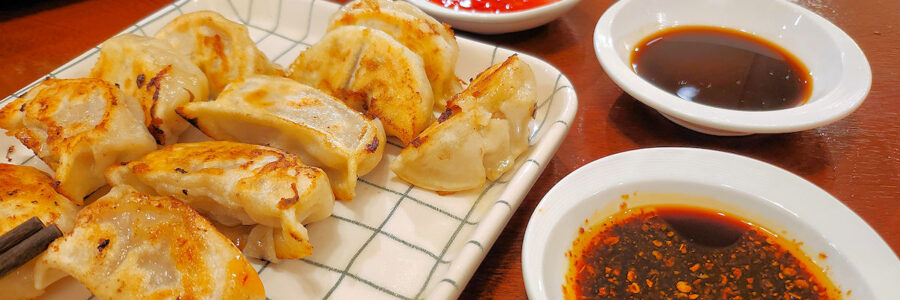
You know I love potstickers. They’re fun to make and even more fun to eat. I got a call about a week and a half ago, very conveniently, from a local “ranch” that raises game birds. Including, it turned out, Mongolian Ring Necked Pheasant - how’s that for coincidence? I decided to give them a try - first off I roasted up one big pheasant (it was 1.3 kilos, which yielded just over half a kilo of meat). Then I coarsely ground the pheasant and added green onions, ginger, roasted garlic, and sesame oil, packed it all into wonton wrappers, then cooked them proper potsticker style. I served them with sauteed mustard greens and a pool of that wonderful hot spicy Chinese mustard.

For a main course, Mongolian Lamb of some sort was a must. I trimmed and cubed lamb shoulder and then marinated it for a few hours in garlic, soy, rice wine, sesame oil, sugar, m.s.g., and cornstarch. For service I sauteed sliced carrots and leeks until just softening, then added the lamb and sauteed it all over very high heat until it was cooked through. We served it simply atop rice.

Date Walnut Yam Cake

Mongolian desserts seem to be mostly of the yak cheese and fruit variety, but there were hints here and there about things with walnuts or dates. I thought I’d see about finding an interesting sort of walnut and date dessert and purely happened across this recipe for a fresh date, yam, and walnut cake - I doubled the recipe and made it as one big cake in a springform pan - I also don’t have fresh dates, but had some lovely Spanish dates left from the big sherry dinner a couple of weeks ago. The cake turns out great, and we garnished it with a toasted half walnut and warm organic honey.

The End

Welcome to The Plateau

Tuesday, July 15th, 2008 12:01 MDT

 Sun, sea, wine and red meat every day. Scientists say a village in Sardinia holds the key to long life.”

- Robert Hardman, UK Daily Mail

Buenos Aires - While I’m gathering my thoughts and notes on Supreme Director Posadas, I thought I’d fill in the time with a little diversion….

A “giara” is a plateau, the most famous of which, the “giara manna” is in south central Sardinia famous for its mysterious miniature horses - mysterious as their ancestry is simply not known. Sardinia, if you’re not sure, is a large island in the Mediterranean that officially is part of the Italian republic, though I’d bet not a Sardinian out there would claim to be Italian. If anything, they probably share more in common with the next neighboring large island, Corsica, which has a similar relationship to France. I can’t claim vast knowledge of Sardinian cuisine - I’ve sampled a dish here and there over the years, I’ve probably even tried my hand at one or two in the kitchen, following a recipe from a book. So when my friend Wayne over at Southern Cone Guidebooks mentioned a new spot serving up the stuff, I put it on my list to check out. Sa Giara, Gurruchaga 1806 in Palermo, 4832-5062, was, to put it simply, delightful.

First, the room - nicely, cleanly laid out, vivid blue and white, nice glassware and flatware, a little gas-fired fireplace off to one side, a charming brick patio in an alcove out front. Our waiter, friendly, effecient, cute… the manager popped by to make some personal recommendations for some of the food. All in all a good beginning.

We started off with some delicious flatbread, variously called carta de musica or pane carasau in different parts of the island, along with two different dips, one of beans the other of chickpeas, both delicious. We ate our way through the flatbread much faster than we should have, and our waiter showed up with more when we were both just considering that we really ought to leave room for lunch. The menu is focused on casual food - a range of tablas, plates of cheeses and cured meats are offered, along with various pastries, all to go with tea, which is stated as a specialty of the house, though it didn’t seem as if their selection was particularly large. There is a small menu of meat dishes - beef, lamb, and pork - and a short selection of pastas, which was the direction we both decided to go for lunch.

Sa Giara - ravioli on pane carasau

My friend opted for something a bit more familiar - fettucine with a simple cream, cheese, and pancetta sauce, I decided to go for one of the traditional Sardinian pastas. I’ll be honest, I forget the name, but it’s an interesting pileup of the crispy pane carasau on the bottom, plump cheese and herb filled ravioli, a fresh tomato sauce with, it seemed, a touch of orange zest, and all topped with a perfectly poached egg. I loved the textural interplay with the flatbread on the bottom, the rich and soft egg yolk, and, well, everything about it. The fettucine was pretty darned good as well. Keeping lunch relatively light, we split the one Sardinian dessert on offer, a sort of big round empanada filled with a ricotta-like cheese and orange, hot and aromatic in a bath of good honey.

Prices are not inexpensive, but that’s becoming more and more common these days. The pastas run around 30 pesos apiece, the specialties slightly more. But, with two pastas, one dessert, two bottles of water, a coffee and a tea (and the ubiquitous cubiertos charge here) it ran us roughly 60 pesos apiece. Still, we’ll be back to try the place again. It was well worth it….

The End

Keep On Keepin’ On

Friday, July 11th, 2008 10:53 MDT

 Stay the course.”

- George W. Bush, president of the U.S.

Buenos Aires - One of the things that fascinates me about history is the way it repeats itself. Despite all those colloquial admonitions about “those who forget the lessons of history are doomed to repeat them”, it’s a common failing throughout the world. We’re seeing it here in Argentina now as various economic, trade, and political policies that have repeatedly led to disastrous results in those fields here are being implemented by the current and antecedent government (let’s face it, they’re one and the same, kind of like if Hillary would have been elected immediately after Bill). One of our guests this last weekend talked a bit about her perception as a porteña in regard to la presidenta - she pointed out that while at the time of the economic collapse, nearly seven years ago, a strong, steady, guiding hand at the helm was needed, and it’s how her husband, Nestor Kirchner, led the country in one fashion or another, out of the disaster, that given the current conditions, that approach is not warranted. Yet Cristina is basically approaching things as if it’s all in disarray and needs to be dealt with swiftly, efficiently, even borderline brutally. It doesn’t - she needs to reevaluate those policies and procedures and adapt them to conditions of today. She’s not. She’s just repeating past actions, regardless of whether they apply to what’s going on or not. — It was an interesting analysis, and rang quite true, and hey, sounds familiar, no?

Today, Argentines regularly talk about that period immediately following the 2001 crisis, bemoaning how sad it was that their country had to go through a succession of leaders rapidly, each one not suited to the task, or betrayed by one another, until finally getting to a relatively stable government. They talk about it as if it’s something historically unusual. True, five presidents in a period of less than a month was a rapid fire version - though, it could easily be pointed out that the first, de la Rúa, simply resigned as inadequate to the task at hand, the second, Ramón Puerta was merely a two day interim appointee to cover until Congress had a chance to meet, Rodríguez Saá was elected and resigned a week later, also not up to handling what was going on, Camaño was once again a couple of day interim appointee, and then Duhalde was elected by Congress and served a bit over a year until the next official election. But this is not the first time Argentina has gone through a quick succession of leaders, though it was the most rapid. From 1976 to 1983 it went through five leadership changes; from 1973 to 1976 it went through four… wait…

It makes more sense to look at when things actually worked, i.e., well, here’s the point, Argentina gained its independence in 1816, though it setup its own government starting in 1810. Since that time the only leaders who served out their entire intended terms were de Rosas from 1829-1832 and again from 1835-1851 (though, in his third term, beginning in 1851, he only lasted a few more months); he was followed immediately by de Urquiza, who stayed in power until 1860; then there were half a dozen changes until a series of three from 1868 to 1886 - Sarmiento, Avellaneda, and Roca - who each served out their terms; then another half dozen changes until Roca was re-elected in 1898 and served until 1904; then again multiple changes until Yrigoyen took over 1916-1922, followed by Torcuato de Alvear from 1922-1928; Justo from 1932-1938; and then no one until Perón served out their entire term, and he only served out his first term - 1946-1952. After Perón, not one president or leader served out their entire intended term until Menem served from 1989-1999, and then Kirchner from 2003-2007. Let’s face it, it’s been a rocky history of leadership, with long stretches where the government changed hands multiple times.

In fact, the country is pretty much built on that as a model. It was directed by a succession of, more or less, committees, the Primera Junta, Junta Grande, First Triumvirate (Argentina), and Second Triumvirate (Argentina) from 1810 to 1820 - and then actually from 1820 to 1826 ceased to exist as a separate entity, becoming a part of the United Provinces of South America. Gervasio Antonio de PosadasThe two juntas there at the beginning truly led as ever-changing committees, the two triumvirates were appointed trios of leaders, until those of the second one realized that they needed, at the very least, a figurehead, if not an official, single leader. And thus, on January 22, 1814, the Second Triumvirate picked one of their threesome (I envision a sort of rock - paper - scissors process) to be the country’s first official solo leader - Gervasio Antonio de Posadas y Dávila, the distinguished looking lawyer in the portrait - who assumed power on January 31st.

He stayed in office for less than a year, followed by Carlos María de Alvear who lasted about four months, José Rondeau for two days, José Ignacio Álvarez Thomas for a year, Antonio González de Balcarce for three months, Juan Martín de Pueyrredón for just under a year, back to Rondeau for a few months, and finally Juan Pedro Julián Aguirre y López de Anaya who managed a week before it was decided no one could remember his whole name and they simply shut the whole government down on February 16, 1820. Six years and eight leaders (seven individuals since Rondeau served twice). Overall, 77 leadership changes in a 198 year history - an average of 2½ years per leader.

It might be time for these folks to take a look at their history and figure out which stuff doesn’t work when they keep repeating it, and what they might do about that… all this, by the way, is leading up to a little walking tour (or several) of the “Supreme Directors” as these seven were known… you know, food, wine, culture, architecture… the stuff you usually get to read about here? Next up, a little “Whatever happened to Gervasio Posadas?” walk…

The End

Green Cape

Thursday, July 10th, 2008 10:55 MDT

 We need to educate our children if we want our continent to prosper, but they can’t learn if they go to school hungry.”

- Cesária Évora, the “Barefoot Diva”, Cape Verdian singer

Buenos Aires - If I were to ask you to tell me a little about Cape Verde, I’m guessing you’d draw a blank. So would I. Beyond knowing that they were (actually I probably thought, “it was one island”) a group of ten islands off the western coast of Africa, I had nothing. I know know slightly more about them - they were uninhabited until the 15th century when Portuguese fleets discovered them and began using them as a transit point for African slave trade, whaling, coal, and resupply. They’ve only been independent since 1975, a mere 33 years, and spent the first 15 of those with a “one-party democracy”, a rather oxymoronic political system, the first multi-party elections were held in 1990. It is now considered the most stable democracy in Africa, though, with only 18 years of real practice, it may be too soon to really make that claim. More than 70% of the fewer than half-million people in the population are Creole, i.e., of mixed Portuguese and African descent, and the food of the islands echos that blend. July 5th is the nation’s Independence Day, and we celebrated with a little reimagination of traditional dishes - brought home all the more strongly by one of our guests who had actually spent time living on the islands at one point (during a fascinating six-year bicycle trip around the world!), who noted that while the flavors were reminiscent of the food there, “no one on Cape Verde eats this well.”

Polenta Cake with Almond-Olive topping

Anyone who knows what a b’stilla looks like knows that this looks nothing like it. It’s a layered savory pastry with a flaky, phyllo style dough, interleaved with meat, vegetables, etc. - often with a touch of sweetness. The Cape Verde version was described in a couple of spots that I could find as being filled with a mix of corn, almonds, honey, and sometimes olives. I decided to abandon form for flavor, and went with a spicy polenta - flavored with garlic, red pepper flakes, black pepper, butter, and grated cheese - after cooking it up to the point where it pulls away from the side of the pan and forms a nice amorphous blob, I poured it into a foil lined, oiled pan, smoothed it out, cooled it, chilled it, and cut it into rounds. For the dinner, I fried the rounds up in a mix of olive oil and butter to give each polenta cake a nicely browned top and bottom. The “salsa” atop is a mix of black and green olives, roasted almonds with mild paprika, onion, red bell peppers, and a splash of orange juice and rum, all topped with some freshly julienned basil.

Next up a delightful little fish soup, quite different from the coconut fish soup that is also a Portuguese influenced fusion dish from our Brazilian dinner a week earlier. This one a simple fish stock made from the fish heads and bones, onions, celery, and black pepper, strained after simmering for an hour. I sauteed up a mix of finely diced vegetables - potatoes, yams, green and red bell peppers, onions - until they were partially cooked, then added diced tomatoes, and lots of chopped green onions and parsley, topped the pot up with the fish stock, and let it all simmer away until the vegetables were fully cooked, then added the fish, a good amount of cubes of corvina, a local type of sea bass, let it cook for about ten minutes more and served.

Diablo Dentro

For me, the most intriguing dish of the cuisine is one called Pastel com Diablo Dentro - the Cape Verdean version of an empanada, with a crust made from a mix of cornmeal and sweet potato, and filled with a spicy tuna mixture. I found only a couple of actual recipes, and some interesting descriptions, including several sources that asserted that this dish is served with a sweet and spicy mayonnaise - sometimes inside with the fish, sometimes as a dip - it was all conflicting enough that I decided to go my own way… surprise, surprise. I went with a simple empanada style crust and made open tartlets. In the bottom, each is filled part way with a puree of roasted yam, simply finished with butter, salt, and a little beaten egg. Atop that is a dice of fresh tuna, onion, tomato, hot peppers, garlic, and corn all sauteed together in a mix of olive and dende (palm) oil. On top, a dollop of freshly made mayonnaise with a mix of palm and corn oils, cayenne pepper, dry mustard, and, finely chopped pineapple along with its juice, and a good sprinkling of chopped chives. It sounds strangely odd, but it’s really quite delicious!

Cachupa

This is the dish that I left closest to its traditional style - perhaps lightly fancied up, but not too much. It’s called cachupa and is considered the national dish of the islands. A stew of hulled white corn, black beans, and lima beans cooked up with a mix of spicy chorizos, morcillas (blood sausage - in this case the slightly cured, firm kind), and some diced pork shoulder. When it’s almost completely cooked I mixed in a pureed of tomato, onion, garlic, and bay leaf, let it finish cooking, then left it to sit for a couple of hours to meld the flavors. I served it over roasted squash slices and topped it with sauteed cabbage (I gather the traditional is served with wedges of the two that have been cooked and then served more as a side to the stew). Hot sauce, of course, avaiable - I went with a simple blend of hot peppers, onions, garlic, and lemon juice.

I came away from my various readings on the country’s cuisine with the impression that dessert tends towards fresh fruit, sometimes with a simple local cheese. I turned it to a ricotta and coconut cheesecake (substituting coconut milk for the regular milk I usually blend in), and then topping it with a mix of diced tropical type fruits (papaya, mango, banana, pineapple) that were just lightly cooked in sugar syrup. And… that’s the name of that tune, as they say.

The End